

-
About Us
-
Functional Module
-
Service and Support


SEMI Report: Global semiconductor equipment sales are projected to reach a record high of US$156 billion by 2027.
Category:
Industry News
Author:
Source:
Release time:
2025-12-23
Visits:
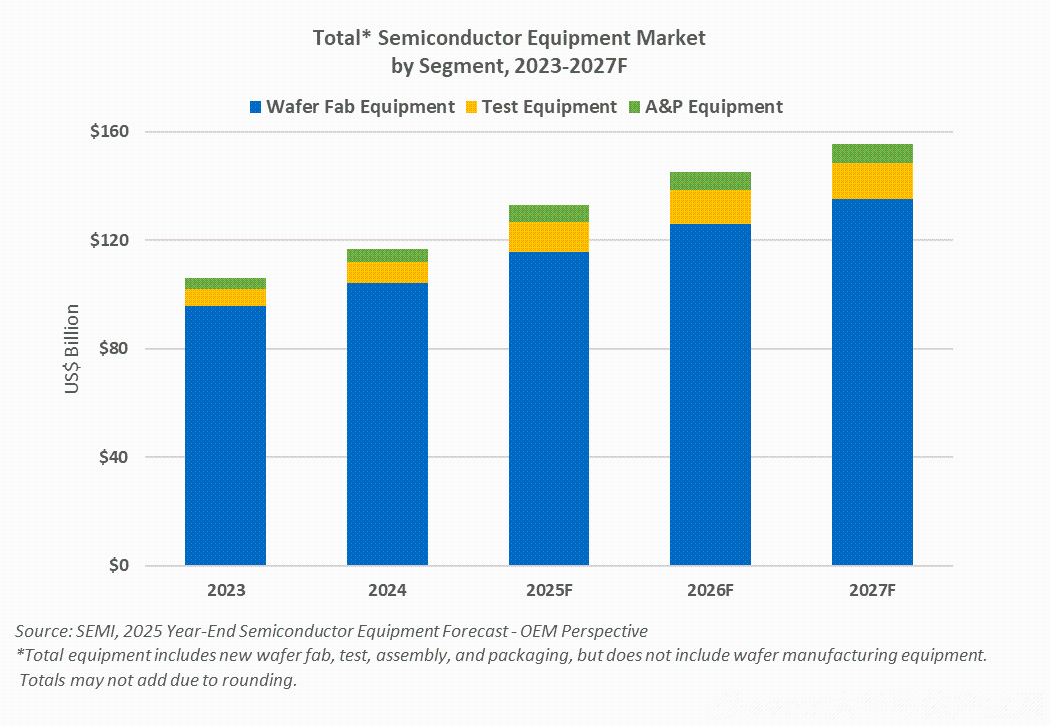
On December 16, 2025, in its “Year-End Total Semiconductor Equipment Forecast – OEM Perspective,” SEMI reported that global original equipment manufacturers’ (OEMs) total sales of semiconductor manufacturing equipment in 2025 are projected to reach US$133 billion, representing a year-on-year increase of 13.7% and marking a new all-time high. In 2026 and 2027, these sales are expected to continue rising to US$145 billion and US$156 billion, respectively. The growth will be driven primarily by investments related to artificial intelligence, covering advanced logic, memory, and advanced packaging technologies.
“Ajit Manocha, President and CEO of SEMI, stated: ‘Global semiconductor equipment sales are showing strong momentum, with both front-end and back-end equipment expected to grow for three consecutive years. Total sales are projected to surpass US$150 billion for the first time in 2027. Since our mid-year forecast, investment driven by AI demand has exceeded expectations, prompting us to revise upward our outlook for all sub-markets.’”
Semiconductor Equipment Sales (by Segment)
After reaching a record high of US$104 billion in 2024 in the wafer fabrication equipment (WFE) sector—including wafer processing, fab facilities, and mask/mask-tool equipment—growth is projected to accelerate by 11.0% in 2025, reaching US$115.7 billion (previously forecast at US$110.8 billion mid-year), driven primarily by stronger-than-expected investments in DRAM and HBM, as well as continued capacity expansion in China. In 2026 and 2027, growth is expected to further increase by 9.0% and 7.3%, respectively, reaching US$135.2 billion, prompting equipment suppliers to ramp up spending on advanced logic and storage technologies.
The backend equipment sector continues the robust recovery that began in 2024. In 2025, semiconductor test equipment sales are expected to surge by 48.1% to $11.2 billion, while packaging equipment sales are forecast to grow by 19.6% to $6.4 billion. In 2026 and 2027, test equipment sales are projected to keep growing at rates of 12.0% and 7.1%, respectively, while packaging equipment sales are expected to increase by 9.2% and 6.9%. The driving forces behind this growth include the rising complexity of device architectures, the accelerating adoption of advanced/heterogeneous packaging technologies, and the stringent performance requirements imposed by AI and HBM. Partially offsetting these factors is the continued weakness in consumer, automotive, and industrial demand.
 WFE Sales (by Application)
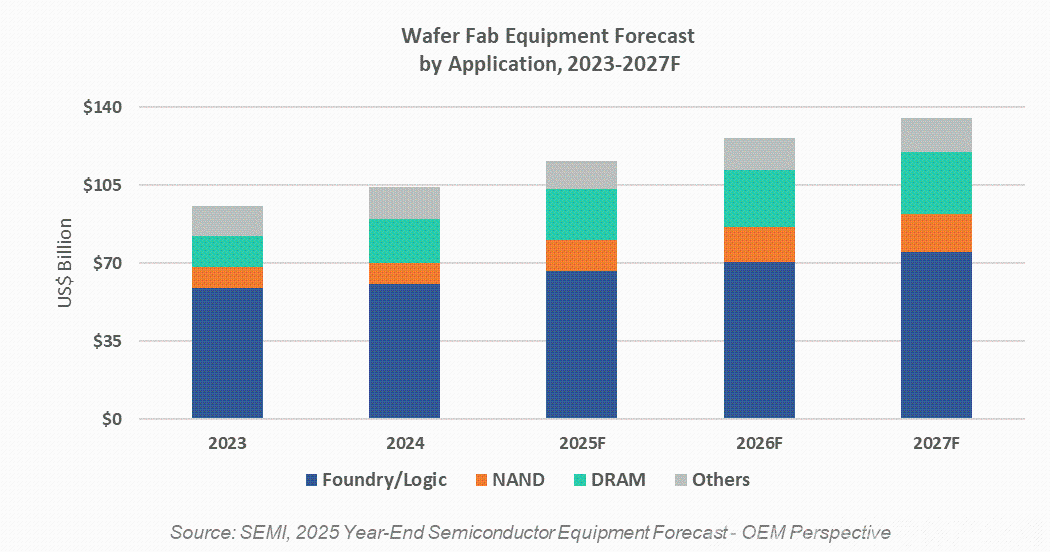
 WFE sales for Foundry and Logic applications are projected to grow by 9.8% year-on-year in 2025, reaching US$66.6 billion, as investment in advanced nodes remains resilient. Growth is expected to continue at 5.5% and 6.9% in 2026 and 2027, respectively, bringing WFE sales to US$75.2 billion. Chip manufacturers are steadily expanding production capacity for AI accelerators, high-performance computing, and high-end mobile processors, paving the way for the industry to move toward large-scale mass production at the 2 nm Gate-All-Around (GAA) node.
Capital expenditures related to storage will expand significantly by 2027, driven by the demand for HBM fueled by AI deployment and advancements in technology iteration. The NAND device market is projected to grow by 45.4% to US$14 billion in 2025, benefiting from advances in 3D NAND stacking technology and the expansion of mainstream production capacity. Growth is expected to continue at 12.7% and 7.3% in 2026 and 2027, respectively, reaching US$15.7 billion and US$16.9 billion. The DRAM equipment market is forecast to increase by 15.4% to US$22.5 billion in 2025, with further growth of 15.1% and 7.8% in 2026 and 2027, as memory manufacturers continue to ramp up HBM production and upgrade to more advanced process nodes to meet the demands of AI and data centers.
Semiconductor Equipment Sales (by Region)
By 2027, mainland China, Taiwan, and South Korea are expected to remain among the top three regions in terms of equipment spending. Mainland China is poised to maintain its leading position throughout the forecast period; despite a slowdown in growth and a gradual decline in sales starting from 2026, local chipmakers continue to invest heavily in mature process technologies as well as select advanced nodes. Taiwan’s spending surged in 2025, largely driven by large-scale construction of cutting-edge production capacity aimed at AI and high-performance computing. Meanwhile, South Korea will sustain high levels of equipment spending thanks to substantial investments in advanced memory technologies such as HBM. With the support of government incentives, regionalized deployment strategies, and the expansion of specialized production capacities, other regions covered in the report are also set for comprehensive growth in equipment spending during 2026 and 2027.
Source: SEMI
Related News

2025/03/05
Technical Support Hotline
E-MAIL:
Technical Support Hotline: 86-13861996325
Address:
4th Floor, Building 5, No. 2 Haiyang South Road, Chengnan Street, Rugao City, Jiangsu Province
Subscribe to us for the latest updates
Mobile Station
WeChat Official Account


Copyright © KOSEN SEMI (JIANGSU) MICROELECTRONICS CO., LTD. All Rights Reserved.