

-
About Us
-
Functional Module
-
Service and Support


SEMI Report: Forecasts Two-Digit Growth in Global 300mm Wafer Fab Equipment Spending in 2026 and 2027
Category:
Industry News
Author:
Source:
Release time:
2026-04-07
Visits:
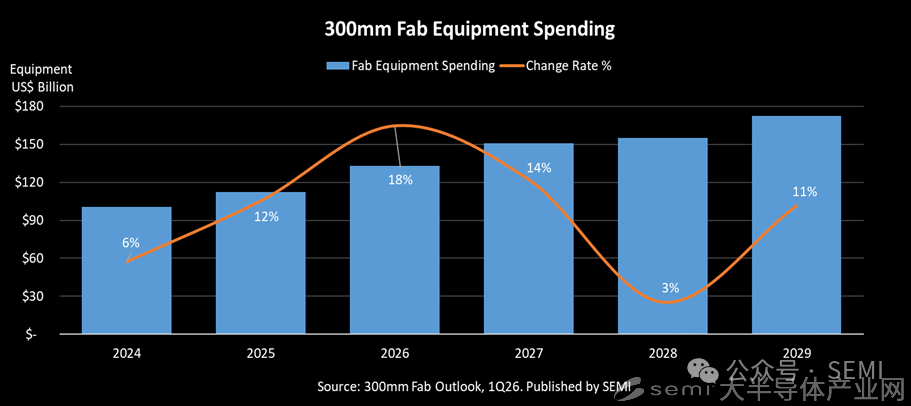
On April 1, 2026, U.S. Pacific Time, SEMI released its latest 300mm Fab Outlook report, which projects that global spending on 300mm fab equipment will grow by 18% to US$133 billion in 2026 and by a further 14% to US$151 billion in 2027. This robust growth reflects the surging demand for AI chips driven by data centers and edge devices, as well as the unwavering commitment of major regions to bolstering semiconductor self-sufficiency through the localization of industrial ecosystems and the restructuring of supply chains.
Looking ahead, the report projects that investment will continue to grow by 3% in 2028, reaching US$155 billion, and then increase by another 11% in 2029, hitting US$172 billion.
“Ajit Manocha, President and CEO of SEMI, stated: ‘AI is reshaping the scale of investment in semiconductor manufacturing. With global spending on 300mm wafer fab equipment projected to surpass US$150 billion for the first time in 2027, the industry is committing unprecedented, sustained capital to build the advanced capacity and resilient supply chains required for the AI era.’”
Growth in Niche Segments
The logic and microelectronics sectors are projected to lead equipment spending from 2027 to 2029, with total investments reaching US$228 billion, driven primarily by robust demand in the foundry industry and by capital expenditures aimed at expanding capacity for advanced process nodes below 2 nm. Advanced process technologies are critical for enhancing chip performance and energy efficiency, thereby meeting the stringent design requirements of diverse AI applications. It is expected that, between 2027 and 2029, an increasing number of advanced process technologies will enter mass production. Moreover, improvements in AI performance are anticipated to fuel substantial growth in edge AI devices across various segments. Beyond advanced processes, demand is forecast to grow moderately across all process nodes and for a broad range of electronic devices, which will in turn support investment in mature process technologies.
The memory sector is projected to become the second-largest segment in terms of equipment spending, totaling US$175 billion from 2027 to 2029. This period marks the onset of a new growth cycle for the sector. Specifically, DRAM equipment spending is expected to reach a cumulative US$111 billion over the same three-year span, while 3D NAND equipment spending is forecast at US$62 billion during the same period.
Driven by the growing demand for AI training and inference, memory requirements have increased substantially. AI training has markedly boosted the need for high-bandwidth memory (HBM), while model inference has placed significant demands on storage capacity, thereby fueling the expansion of NAND flash applications in data centers. This robust demand has prompted sustained high levels of investment in the memory supply chain over the near term and the medium to long term, helping to mitigate potential downturns that could arise from traditional storage-cycle fluctuations.
Regional Investment Trends
From 2027 to 2029, global capital expenditure on 300mm wafer fab equipment is expected to be broadly distributed across major semiconductor manufacturing regions, reflecting the combined impact of factors such as the expansion of advanced process nodes, increased memory capacity, and supply-chain localization driven by policy support. Mainland China, Taiwan, South Korea, and the Americas will all see large-scale investments during this period, while Japan, Europe and the Middle East, and Southeast Asia will continue to expand their investments from a smaller base.
In mainland China, investment is expected to continue benefiting from supportive government policies and initiatives. In Taiwan, spending is projected to be primarily driven by the ongoing expansion of advanced foundry capacity, including 2nm and below technologies. In South Korea, investment remains closely tied to the memory sector, with AI-related demand underpinning a new cycle of capacity expansion and technology upgrades. In the Americas, expenditure is anticipated to be supported by the expansion of advanced process nodes and broader efforts to strengthen local manufacturing ecosystems.
Japan, Europe, the Middle East, and Southeast Asia are also expected to experience significant growth by 2029. In these regions, capital expenditure is being bolstered by government incentives, supply-chain resilience strategies, and targeted efforts to expand semiconductor manufacturing capacity.
As part of the SEMI Fab Forecast database, the SEMI 300mm Fab Outlook report covers 404 facilities and production lines worldwide and reflects 198 updates and 9 new fab/line projects since the last release in December 2025.
Source: SEMI Network
Related News

2025/03/05
Technical Support Hotline
E-MAIL:
Technical Support Hotline: 86-13861996325
Address:
4th Floor, Building 5, No. 2 Haiyang South Road, Chengnan Street, Rugao City, Jiangsu Province
Subscribe to us for the latest updates
Mobile Station
WeChat Official Account


Copyright © KOSEN SEMI (JIANGSU) MICROELECTRONICS CO., LTD. All Rights Reserved.